Review by Agnes Kory on Seen and Heard international
I do not understand why Concerto Budapest’s five-city UK/Ireland tour has been promoted with the unwieldy name of Concerto Budapest Symphony Orchestra. In my view, this excellent Hungarian orchestra should be promoted and known with its own name. In their reports, several reviewers – somewhat understandably – shortened the long English name to CBSO which, unfortunately, brings the other CBSO (City of Birmingham Symphony Orchestra) to mind.
For their five-city UK/Ireland tour Concerto Budapest planned/brought three programmes:
PROGRAMME A (29.11.25 National Concert Hall, Dublin; 7.12.25 Usher Hall, Edinburgh)
Tchaikovsky – Francesca da Rimini
Beethoven – Piano Concerto No.3
Liszt – Les Préludes
PROGRAMME B (2.12.25 Warwick Arts Centre, Coventry)
Liszt – Les Préludes
Beethoven – Piano Concerto No.3
Shostakovich – Symphony No.9
Tchaikovsky – Francesca da Rimini
PROGRAMMEC (3.12.25 Symphony Hall, Birmingham; 4.12.25 Cadogan Hall, London)
Shostakovich – Symphony No.9
Beethoven – Piano Concerto No.3; Symphony No. 5
Liszt – Les Préludes
I am not sure if, in the event, the programmes were delivered as planned but, for sure, programme A was delivered at the Cadogan Hall. The Beethoven piano concerto was constant at all concerts, always as the centre piece. According to the plan, the other constant element was Liszt’s Les Préludes although it did not always have the same place in the order. I wonder how programs A, B and C were allocated to the five cities but, at any event, the changes – however slight – would have given a bit of variety to the players. Conductor András Keller and soloist Paul Lewis participated in each programme.
András Keller is a committed, highly gifted musician. I was privileged to witness many of his excellent chamber music concerts over the decades; I still vividly remember his interpretation as first violinist of Bartók string quartets and Kurtág’s Kafka Fragments. By now, Keller is also a good conductor: the compositions presented on this tour require significant conducting skills, it is not enough to be a good musician. At the Cadogan Hall, Keller gave a true account of the scores, provided beauty and excitement in equal measures. Furthermore, during the Beethoven symphony I could not help thinking that, before long, Keller should tackle Beethoven’s Fidelio.
Piano soloist Paul Lewis provided a performance with intelligence, integrity, discipline and virtuosity. His phrasing was faultless, providing much beauty. Lewis was in the driving seat, Keller and the orchestra gave full support. The result was highly satisfying, but I was wondering if Concerto Budapest could bring a Hungarian pianist to their next tour. There are many fine Hungarian pianists who are lesser known than Lewis but also bring high quality to Concerto Budapest concerts.
Concerto Budapest is an excellent orchestra with excellent players. They have two leaders who sit next to each other but alternate. On this concert, Liu Miranda led the Shostakovich symphony and played the short violin solo in the first movement while Zsófia Környei led the rest of the programme. In the Shostakovich bassoonist Bálint Mohai, clarinettist Csaba Klenyán and trumpeter Gábor Devecsai particularly excelled in their solos.
In the piano concerto flute (Orsolya Kaczander) and bassoon (Mohai) warmed my heart with their second movement dialogue over the solo piano’s arpeggios and so did the beautiful first clarinet motives.
Liszt’s Les Préludes showed tremendous skills by the brass section but also some lovely oboe solos (Béla Horváth). The huge orchestra needed for the piece demonstrated to me that Keller is a capable conductor, not ‘only’ a highly musical violinist.
In the Beethoven symphony Keller was not afraid of brisk tempos, a wide range of dynamics (down to the softest pianissimos) and exciting accelerando. However, all of Keller’s choices are integral to the score, sensationalism is not one of his tools.
Timpanist Boglárka Fábry is a treasure. Rock solid with her rhythm but equally very sensitive with her scale of dynamics: she is an excellent centre of the orchestra.
On conclusion of the planned programme, spirited encores cheered us on: the Poarga Românească (Romanian Polka) and Mărunțel (Fast Dance) from Bartók’s Romanian Folk Dances, followed by Brahms’s Hungarian Dance No.5. The Brahms dances are not Hungarian although Brahms heard the motives in Hungary. However, this particular dance does have a short section from a Hungarian folk song (‘Úgy tetszik, hogy jó helyen vagyunk itt’).
Concerto Budapest made a lot of people very happy with their concerts. May they continue so for a long time to come
Agnes Kory
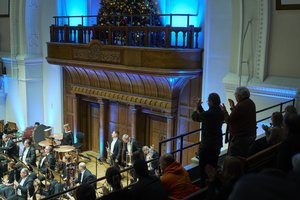
Featured Image: Pianist Paul Lewis, conductor András Keller and Concerto Budapest at Cadogan Hall © Valuska Gábor