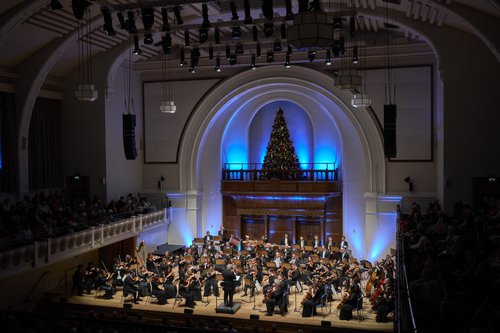
Pianist Paul Lewis and conductor András Keller Birmingham Usher Hall © Valuska Gábor
Opening, however, with Tchaikovsky’s Francesca da Rimini was a little unusual, demanding a greater degree of music-making than is normal in concert programmes; the passion and intensity of performance is more often left to the latter part of the programme; however, the orchestra rose to the task with exquisite playing from the wind groups, especially from the brass. The large string section was remarkable with their richly nuanced tone, and there was a noticeable golden bloom in the first violins. The violas and cellos were fluent and impressive, evincing all the romanticism of this piece. The narrative of the Fifth Canto from Dante’s Inferno was expressed with outstanding musicality by the clarinet of Gaba Klenyán, and by Kaczander Orsolya on the flute, and special mention too for the timpani of Boglárka Fábry.
In the Beethoven Piano Concerto, the orchestral introduction was heroic and majestic, and the first bars on the Steinway by Paul Lewis were sublime, with the English pianist showing magnificent articulation. Throughout, it was noticeable that there was little eye contact between the conductor and the soloist – but this was the fifth playing of this concerto on this tour, so perhaps little understanding or discussion was required, as everything was prepared in advance. Again, as in the Tchaikovsky piece, the finest playing was from the orchestra’s wind players, especially the clarinet and flute! They were matched in virtuosity by Béla Horváth on the oboe and the bassoon of Bálint Mohai. Following the grand opening, the playing was magnificent, especially in the elegiac slow movement and in the spiritually refreshing finale. András Keller ensured that this work is more of a dialogue between orchestra and soloist, with equal roles and expression shared.
Another novel choice in the programme was opening the second part with Liszt’s Les Préludes, a work of considerable power and a symphonic poem which struggles to win audiences over, yet here the Hungarians were well on top of this powerfully emotive work. The nuancing of orchestral colour by the conductor was quite remarkable here and a highlight of the concert.
Finally, the orchestra kept their best for the Beethoven Fifth, and I have not heard such a powerful performance of this symphony for many years. Keller certainly directed the work as the ‘symphony of fate’ in his direct and forceful interpretation. Rather than take the repeats, the conductor chose to emphasise the power and strength of Beethoven’s ideas, revealing this as a truly revolutionary work.
The famous opening bars of the Allegro con brio were deliberately slower, with Keller allowing the full weight of the opening chords to be heard before driving into the stormy pages of the first movement. Now the strings were playing as if their life depended on it in a very dramatic passage of performance. The second movement (Andante con moto) was distinguished by magnificent solos from the woodwind, especially the flute of Orsolya. Here, the composer’s faith in happiness and beauty came to the fore.
The themes from the opening movement were reprised in the third movement, as the lively dance broke out on the lower strings, yet darkness emerged briefly, and the Allegro finale rose like a beam of sunlight in the darkness. Finally, triumph emerged on the brass for the powers of fate, with the whole orchestra storming to victory. The degree of intensity conjured up by András Keller was outstanding, and the glorious finale was met by a storm of applause. This was quite a remarkable performance led by a great conductor, and his ensemble are virtuoso musicians who could grace any orchestra.
‘Haste ye back’ was a phrase I heard several times on leaving the Usher Hall.
Gregor Tassie
photo: Gábor Valuska
A decidedly traditional one too, in some ways, with theapproach firmly on “great works, great playing”. No panderingto 21st-century trends either: the “no phone” paddles werefi rmly brandished by the concert stewards.
But if that implies a frozen-in-aspic playing style from an orchestra whose history stretches back more than a
century, then I’m misleading you.Under the unflashy direction of artistic director Andras Keller,these musicians were firmly in the moment, playing with realzeal and passion.
Their Shostakovich Symphony No 9 set the bar high. A sardonic Soviet composer might seem like an odd place to begin a concert rooted in the Classical era, but this symphony finds Shostakovich in neo-classical mode, writing for compact forces,wryly playing with sonata form, and subverting the authority’sexpectations for a grand symphony celebrating victory in 1945.
The orchestra brought bags of character to its playing, from perkily alert strings to a wild-edged trumpet solo — so good itmade one of the bassoonists smile. In answer, the bassoonist’s own solo in the Largo was an absolute highlight, wonderfully expressive and fully deserving of the cheers at the end.
Talking of soloists, our pianist in Beethoven’s Piano ConcertoNo 3, which stands poised between Classicism and Romanticism, was the unfailingly eloquent Paul Lewis, who forthe most part found a happy balance between fervour andrestraint. And we plunged fully into the Romantics’ artistic world in a stirring reading of
Les Préludes by Liszt, one of Hungary’s great heroes.
Perhaps it was a curious choice to end with Beethoven’s Fifth Symphony, given the orchestra also played it on its fi rst tourjust three years ago, but there was no shortage of conviction,even if one or two ragged edges showed.
There was an appealing sense of Romantic wonder too, with the Allegro con brio’s oboe solo breaking through as if the clouds were clearing around a full moon, and an almost ghostly atmosphere to the Allegro’s opening.
Encores were in order, sending us back out into the chilly nightwarmed by the fi re of Romanian and Hungarian Dances byBartok and Brahms.
photo: Gábor Valuska
Concerto Budapest Symphony Orchestra, Symphony Hall Birmingham
Beethoven’s Third Piano Concerto and Fifth Symphony, and in between Liszt’sbest-known symphonic poem
Les Préludes. Only the mocking cheerfulness ofthe opening piece, Shostakovich’s Ninth Symphony, struck an unusual note.But the gamble paid off. The Concerto Budapest SO played these well-known pieces as if their lives depended on it, and brought out such a wide range of colours that they seemed startlingly unfamiliar.
The orchestra’s conductor, András Keller, doesn’t give a damn about framing a quirky programme. According to his programme note, he wants to “explore the enormous struggles we might face in our path to attaining redemption or fulfilment”. To do that he feels only lofty masterpieces will do.
It’s a tonic simply to encounter that faith in the art form. Shostakovich’ssymphony, which premiered a few months after the end of the Second World War, can sound like a jolly romp calculated to annoy the Soviet cultural commissars. Here the perkiness had a bitter edge. One could see the skull beneath the grin in those heartless piccolo chirrupings.
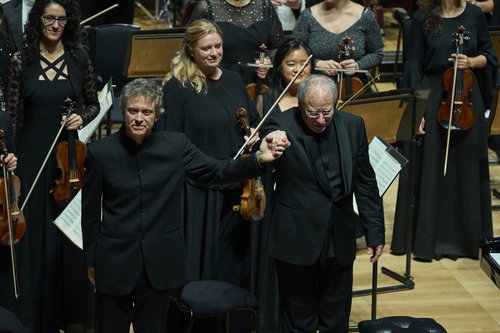
The slow movement, by contrast, had a perfect aloof coolness, almost beyond human feeling. Keller’s baton technique is certainly unorthodox, with atremblingly expressive left hand that reminded me of the now vanished Russian conductor Valery Gergiev. But it’s certainly effective. The pacing ofthe final mad dash to the finish line was impeccable.
That was the best performance, but the other performances were not far behind them. In Beethoven’s Third Piano Concerto the soloist was Paul Lewis– absolutely the right pianist to bring out the stern, chiselled grandeur in the music, though he also found a huge and yet tender spaciousness in the slow movement, and a range of far-away colours for those moments in the finale that seem to lift us up to the stars.
In Liszt’s Les Préludes one became aware of other qualities of this orchestra.They found a new, subtly layered, Wagnerian sound, exactly right for the way the music seems to beckon at distant hazy horizons, which then come intotriumphant focus. As for the finale, Beethoven’s Fifth, it had a thrillingurgency given extra bite by the orchestra’s fabulously pungent horn section. And let’s not forget the huge, yearning tone of the principal bassoonist whoreceived his own personal ovation at the end.
© Dublin National Concert Hall Mark Stedman
Concerto Budapest returned to Dublin last night, only two years after their last impressive appearance, and once again proved its mettle. Under the direction of András Keller, who has led the ensemble since 2007, this century-old orchestra delivered a programme steeped in high-Romantic drama: two C minor masterpieces by Beethoven forming the backbone of the evening, framed by Tchaikovsky and Liszt symphonic poems.
From the ominous opening brass and glowing cellos in Tchaikovsky’s Francesca da Rimini, Keller helped create a miasma of despair, worthy of Dante’s doomed lovers. The strings exchanged rapid, razor-edged figures with the woodwind and brass, their chromatic surges whipping up a convincing sense of terror. Yet amid the violence came moments of delicacy – the plaintive, beautifully shaped clarinet solo for Francesca, and a dancing, flirtatious flicker from the flute – proof that Keller could balance the work’s lurid intensity with moments of tender pathos.
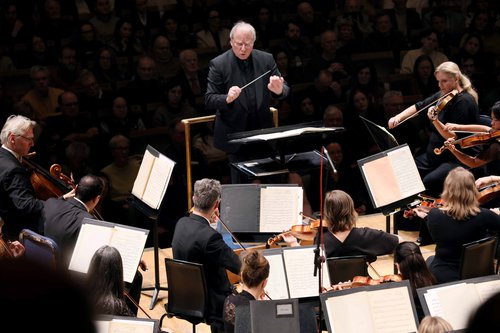
András Keller © Dublin National Concert Hall Mark Stedman
Paul Lewis then joined the orchestra for Beethoven’s Third Piano Concerto, attacking the rising scales with near-savage drive while the later staccato arpeggios possessed a limpid quality like stones skimming across still water. The second theme, though poised, felt a shade too plain, wanting a little more expressive warmth. Keller, meanwhile, kept the orchestral texture lean and almost classical in outline, though Lewis tore free of restraint in the cadenza, attacking it with a tightly coiled ferocity.
Lewis shaped each phrase of the second movement with an architectural beauty that was matched by sumptuous strings. Here the hushed pianissimo arpeggios provided a backdrop to the soaring melody above. The Rondo hurtled forward with nervous energy. Some of the rapid triplet passagework lost clarity and on at least one occasion the orchestra was a little disjointed but overall there was no doubting the terrific panache and verve with which both Keller and Lewis imbued this finale.
Liszt’s Les Préludes opened the second half in a blaze of colour. Keller’s attention to detail was striking: violin lines buoyed by feather-light woodwind staccato, woodwind phrases shaped with particular finesse, and textures that never grew muddy even as Liszt’s rhetoric swelled towards its triumphant climaxes. The brass blazed, the percussion thundered, yet the music retained a clear narrative arc.
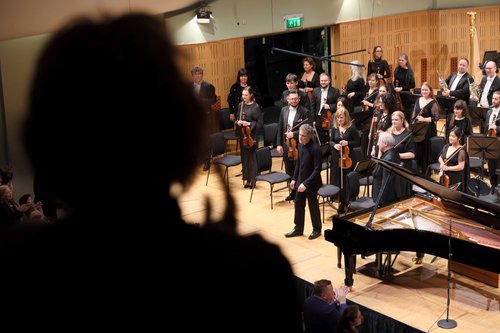
Paul Lewis © Dublin National Concert Hall Mark Stedman
Just as in Cana, the finest wine was kept to last and Beethoven’s Fifth Symphony justifiably brought the house down. This was a bold, high-voltage reading, Keller unafraid to push tempos to the brink. The Fate motif exploded with visceral force and the first movement crackled with urgency. Momentum gathered steadily through the Scherzo, the transition into the finale delivered with a sweeping grandeur. The coda was taken at an exhilarating pace – thrillingly fast but just within the bounds of control. This was Beethoven with the brakes off, and under Keller’s bold stewardship it brought the evening to a jubilant, breathless close.
Read the original review on Bachtrack's website, click HERE!
For their five-city UK/Ireland tour Concerto Budapest planned/brought three programmes:
PROGRAMME A (29.11.25 National Concert Hall, Dublin; 7.12.25 Usher Hall, Edinburgh)
Tchaikovsky – Francesca da Rimini
Beethoven – Piano Concerto No.3
Liszt – Les Préludes
PROGRAMME B (2.12.25 Warwick Arts Centre, Coventry)
Liszt – Les Préludes
Beethoven – Piano Concerto No.3
Shostakovich – Symphony No.9
Tchaikovsky – Francesca da Rimini
PROGRAMMEC (3.12.25 Symphony Hall, Birmingham; 4.12.25 Cadogan Hall, London)
Shostakovich – Symphony No.9
Beethoven – Piano Concerto No.3; Symphony No. 5
Liszt – Les Préludes
I am not sure if, in the event, the programmes were delivered as planned but, for sure, programme A was delivered at the Cadogan Hall. The Beethoven piano concerto was constant at all concerts, always as the centre piece. According to the plan, the other constant element was Liszt’s Les Préludes although it did not always have the same place in the order. I wonder how programs A, B and C were allocated to the five cities but, at any event, the changes – however slight – would have given a bit of variety to the players. Conductor András Keller and soloist Paul Lewis participated in each programme.
András Keller is a committed, highly gifted musician. I was privileged to witness many of his excellent chamber music concerts over the decades; I still vividly remember his interpretation as first violinist of Bartók string quartets and Kurtág’s Kafka Fragments. By now, Keller is also a good conductor: the compositions presented on this tour require significant conducting skills, it is not enough to be a good musician. At the Cadogan Hall, Keller gave a true account of the scores, provided beauty and excitement in equal measures. Furthermore, during the Beethoven symphony I could not help thinking that, before long, Keller should tackle Beethoven’s Fidelio.
Piano soloist Paul Lewis provided a performance with intelligence, integrity, discipline and virtuosity. His phrasing was faultless, providing much beauty. Lewis was in the driving seat, Keller and the orchestra gave full support. The result was highly satisfying, but I was wondering if Concerto Budapest could bring a Hungarian pianist to their next tour. There are many fine Hungarian pianists who are lesser known than Lewis but also bring high quality to Concerto Budapest concerts.
Concerto Budapest is an excellent orchestra with excellent players. They have two leaders who sit next to each other but alternate. On this concert, Liu Miranda led the Shostakovich symphony and played the short violin solo in the first movement while Zsófia Környei led the rest of the programme. In the Shostakovich bassoonist Bálint Mohai, clarinettist Csaba Klenyán and trumpeter Gábor Devecsai particularly excelled in their solos.
In the piano concerto flute (Orsolya Kaczander) and bassoon (Mohai) warmed my heart with their second movement dialogue over the solo piano’s arpeggios and so did the beautiful first clarinet motives.
Liszt’s Les Préludes showed tremendous skills by the brass section but also some lovely oboe solos (Béla Horváth). The huge orchestra needed for the piece demonstrated to me that Keller is a capable conductor, not ‘only’ a highly musical violinist.
In the Beethoven symphony Keller was not afraid of brisk tempos, a wide range of dynamics (down to the softest pianissimos) and exciting accelerando. However, all of Keller’s choices are integral to the score, sensationalism is not one of his tools.
Timpanist Boglárka Fábry is a treasure. Rock solid with her rhythm but equally very sensitive with her scale of dynamics: she is an excellent centre of the orchestra.
On conclusion of the planned programme, spirited encores cheered us on: the Poarga Românească (Romanian Polka) and Mărunțel (Fast Dance) from Bartók’s Romanian Folk Dances, followed by Brahms’s Hungarian Dance No.5. The Brahms dances are not Hungarian although Brahms heard the motives in Hungary. However, this particular dance does have a short section from a Hungarian folk song (‘Úgy tetszik, hogy jó helyen vagyunk itt’).
Concerto Budapest made a lot of people very happy with their concerts. May they continue so for a long time to come
Agnes Kory
Featured Image: Pianist Paul Lewis, conductor András Keller and Concerto Budapest at Cadogan Hall © Valuska Gábor
Shostakovich’s Seventh (Leningrad) and Eighth Symphony – considered by many to be a more effective response to the experience of war – were the first two parts of what was expected to be a trilogy of war symphonies. He promised a large-scale work, possibly with a vast chorus, but his heart was not in this project and he abandoned the plan. Symphony No 9 was composed quickly in 1945 and premièred in Leningrad in the November. In his own words, the work is a “merry little piece” and maybe frivolous, particularly in the opening movement when a piercing piccolo chirps over a low trombone and percussion. In short, the Ninth is very different but was handsomely played with attractive bassoon and clarinet solos driven at pace by a most effective percussion section.
This Budapest team presented a magnificent trombone fanfare to announce Liszt’s Les Préludes with the horn colleagues adding to the excitement, the work providing a thrilling start to this diverse programme.
Paul Lewis is a foremost interpreter of the works of Beethoven and Schubert and duly delivered one of those delightfully subtle and sensitive performances of Beethoven’s Piano Concerto No 3 in C Minor, devoid of any irritating mannerisms. With a sparkling cadenza in the first movement, pleasing lyricism of the simple melodies in the middle one and a stimulating climax, this was Lewis at his best. Conductor András Keller clearly enjoyed this performance and delighted the audience with two encores of Hungarian dances by Bartók and Brahms.
The performance took place on Tuesday December 2.
Regarding the interview, Imre Szabó-Stein, the Orchestra’s International Strategic Chief Advisor, commented as follows:
“It is a great honour and recognition that BBC Radio 3’s iconic programme In Tune conducted a live interview yesterday at 6:30 p.m. UK time with András Keller on the occasion of Concerto Budapest’s third UK tour. The conversation, hosted by Katie Derham—an extremely popular radio and television personality in Britain—took place during peak airtime. We are now sharing this short yet remarkably profound discussion. In just a moment—well, that’s an exaggeration: tomorrow morning—Concerto Budapest sets off on its third major tour of England and Ireland.
Concerto is a place where we like to set the bar very high—sometimes seemingly impossibly high—not only musically, but also in terms of leaving a mark on the international and Anglophone media with the orchestra’s tour, as if it were the event of the year. Let’s admit, this is rather challenging in a country that is one of the world’s classical music strongholds, where the world’s leading orchestras and soloists take to the stage one after another.
Yet in 2022 and 2023 we succeeded: the highly appreciative, serious and extensive reviews in The Times, The Guardian, The Telegraph and the most important music journals served as beacons of our success. Thanks in part to this, full houses await the art and virtuosity we bring—both at the National Concert Hall in Dublin and at London’s Cadogan Hall. The BBC Radio 3 interview signifies our arrival.”
Paul Lewis & András Keller Symphony Hall,Birmignham 3 December, 2025 © Gábor Valuska
Pianist Paul Lewis returns to Edinburgh this weekend. He tells KEN WALTON why ‘just being yourself’ is the key to honest fulfilment amid the noise of social media
Mention the name Paul Lewis, and the music that immediately springs to mind are the seminal piano canons of the great Viennese classicists: Haydn, Mozart, Beethoven and Schubert. “It’s definitely the core of my repertoire,” confirms the 53-year-old Liverpool-born pianist, though pigeon-holing him in such a way is not altogether accurate.
“This year I’ve been playing a big new Piano Sonata by [Austrian pianist/composer] Thomas Larcher, and over the next few years I’ll be embarking on a series of recitals that cast Mozart in context with the likes of Poulenc, Debussy, Webern and Copland. ”I’m hoping the connections will be audible.” Knowing Lewis’ persuasive expressiveness and intellect, that’s a given.
That said, Lewis is in Edinburgh this weekend for an Usher Hall concert marking the only Scottish date in a five-city UK/Ireland tour with the idiosyncratic Concerto Budapest Symphony Orchestra, in which he turns his attention back to Beethoven. He’ll perform the Third Piano Concerto under the orchestra’s music director András Keller, who also conducts Tchaikovsky’s symphonic fantasy Francesca da Rimini, Liszt’s Les Preludes and Beethoven’s Symphony No 5.
Lewis dates his early fascination with Beethoven to frequenting the local Liverpool record library as an 8-year-old. “I guess the librarian there must have had a certain influence on the recordings it stocked. There was a lot of that central Germanic repertoire, coincidentally all of Alfred Brendel’s early Beethoven recordings for VOX/Turnabout in the 1960s.”
At the time, Lewis had not yet seriously engaged with the piano – progress as a budding cellist was proving more arduous than a natural calling – and it wasn’t until he headed to Manchester and the famous Chetham’s specialist music school, that his true metier at the keyboard blossomed. “Later in my teens I turned towards the Romantic piano virtuoso repertoire, but by the time I was a student in London I was focussing again on Haydn, Beethoven and Schubert. I came back to that quite quickly.”
Then he met Alfred Brendel, and with that an opportunity to have lessons with the legend whose recordings had so influenced him as a youngster. “It was such an honour to have that access to him in the ‘90s. Every time I played to him it felt like a door opened musically speaking. He was such a powerful musical personality and had such strong convictions,” Lewis recalls.
“He was so persuasive in the way he communicated things, especially helping you think more creatively about the piano, how to treat it as anything but a piano, which was quite an eye-opener for me. It could be an orchestra, a chamber ensemble, a human voice or a single wind instrument. It was just so inspiring.”
The process was arduous but rewarding, Lewis recalls. “I found I’d play him something and it would take time for me to translate and successfully assimilate all the information. Yes, he was very prescriptive, very specific and exacting in lessons, but in the end he was really only interested in unleashing the personal conviction behind a performance, not in producing clones of himself. I soon realised the worst thing you could do is simply copy him, as all you’d end up with would be a bad version of Alfred Brendel. He wasn’t looking for that.”
Summing up the legacy of Brendel, who died earlier this year, Lewis turns again to shared enthusiasms. “He was the first person to record all of Beethoven’s piano music, and the first person to bring Schubert’s sonatas, previously neglected, into mainstream concert programmes. It’s strange to think he even introduced Liszt to Viennese audiences, a figure they traditionally turned their noses up at. Brendel persisted in what he believed was really worthwhile. Honesty and integrity were always at the centre of what he did.”
These qualities apply equally to Lewis, whose own critically-acclaimed recordings of Beethoven and Schubert, dating from over two decades ago, are already approaching the stuff of legend. What fascinates him most about these, especially the Beethoven, is how differently he views them today. “They would be very different if I recorded them now,” he confirms. “What changes over time is the balance you see between different elements of the music. Back then I get the impression I was looking more towards the lyrical quality of Beethoven, whereas these days I’d probably look towards the dramatic side. I guess you live your life and it feeds into what you do in ways you don’t necessarily understand.”
Lewis’ life has changed immeasurably in recent years, having shifted his family home to Norway (his wife, cellist Bjørg Lewis, is Norwegian), though maintaining a UK base in Buckinghamshire, where he and his wife jointly direct the annual chamber music festival Midsummer Music. He’s also begun to teach, having succeeded his friend, the late Lars Vogt, as a professor at the Hannover Hochschule für Musik.
“It’s the kind of thing I’ve wanted to get more involved with in recent recent years, with young pianists, and often wondered how to do it,” he says. “This seemed like a good opportunity and something I feel I need to do responsibly, so I’m gradually building up a class one student a year and trying to be there as much as I need to be.”
Is there any particular piece of advice he’d like to offload on young pianists today? “I’ve had the career that I wanted to have, focussing early on on certain composers for maybe a year or two, Beethoven and Schubert for instance. I didn’t know it at the time, but looking back it kind of defines you as a certain type of musician and brings an identity along with it.
“These days, with the whole noise of social media, everyone’s out there sort of shouting, so it’s even more important to find a really distinctive identity, though how one does that is another question. My advice is to just be true to the musician you are, have very strong convictions about things. It’s the only way you’re going to convince anyone else. Don’t try to be anything you’re not because you think it will bring x, y or z results in career terms. Just try and stick to your honest musical path.”
Sound advice from a musician whose own journey has been fascinating; who has proved himself to be the genuine article.
Paul Lewis performs Beethoven’s Third Piano Concerto with the Concerto Budapest Symphony Orchestra at the Usher Hall on Sun 7 December. Full information at www.cultureedinburgh.com
This way of thinking has been a modus operandi informing Keller’s career for decades, and is now in the foreground of his activity as a conductor and artistic director. A few weeks before the start of Concerto Budapest’s upcoming tour in the United Kingdom and Ireland, I talk to Keller about his involvement with the ensemble and their bustling schedule for the new season.
Coming right after a successful all-Bartók festival in Keller's native Budapest, the ensemble’s third major tour in the British Isles is particularly ambitious, covering major venues in Dublin, Coventry, Birmingham, London and Edinburgh. The programme – or rather, programmes – features different combinations of five pieces: Tchaikovsky’s Francesca da Rimini, Liszt’s Les Préludes, Beethoven’s Fifth and Piano Concerto no. 3 with the participation of Beethoven virtuoso Paul Lewis, as well as Shostakovich’s Ninth Symphony. Typically for the conductor, the concerts trace a specific aesthetic route and come with a title, ‘From the Depths of Hell to the Heavens’, reminiscent of a Dantesque ascension. Before stepping into the underworld, however, I ask Keller to introduce the ensemble who will accompany him along the journey.
“In my almost twenty years with Concerto Budapest, I have seen them develop in incredible ways,” he says. “I was appointed as Chief Conductor and Artistic Director in 2007, on their 100th anniversary, and it hasn’t always been easy: at that time the ensemble wasn’t in the best shape, and I could tell there was a lot of margin for improvement. Coming from chamber music with the Keller Quartet, I have always believed in a communicative, horizontal approach to music, so that’s what I pursued. We worked hard to cultivate a common language, so that we could mature together – which meant, first of all, finding our roots again.”
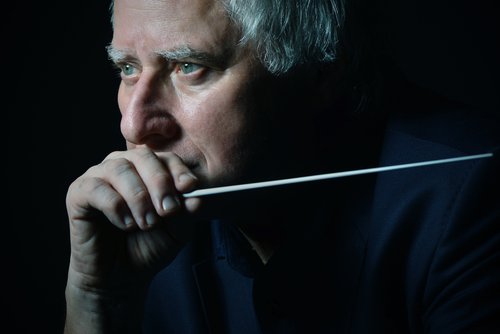
photo: Vera Éder
Soon enough, Keller began to arrange the orchestra’s programmes around specific sections of repertoire. A few seasons were dedicated to Mozart’s Piano Concertos and Haydn’s London Symphonies, followed by Beethoven and Bartók and eventually landing on Mahler. Finally, the hard work started paying off: “From those roots we grew a robust tree. This wouldn’t have been possible without the commitment and indefatigable efforts of all our musicians. Gathering for a shared goal, creating something together – that’s the very purpose of music. In a way, a symphony orchestra could be seen as a form of real democracy. ‘One for all, all for one’, as Dumas puts it. Sure, there is a conductor, but everyone – regardless of their background and identity – sacrifices so much of themselves just to give something to people. This idea informs our existence as an ensemble.”
These principles have been passed on to the conductor by a very special mentor. “It is what I learnt from my master, György Kurtág. No music can ever be genuine if you don’t give your all. I always keep this in mind when I perform or plan programmes for future concerts.”
As the Artistic Director of Concerto Budapest, Keller adopts an intuitive, rather than cerebral approach to programming seasons and tours. His concerts often have an implicit or explicit theme, constructed through relations that aren’t always obvious. Kurtág’s laconic poetics, of sudden, interrelated, brief illuminations, permeate Keller’s words. “To me, all the pieces in a programme should be connected – not overtly, but through a secret hidden thread that binds them in another dimension,” he explains.
“Most times, these associations come to me instinctively and I realise only afterwards that they were a good choice and had strong emotional resonance. I don’t only care about playing well; I care about leaving people with something that will make their lives better, a purely human core if you will. Ultimately, our job is to uplift society.”
The selection of pieces scheduled for the UK and Ireland tour is a case in point. The title alone, ‘From the Depths of Hell to the Heavens’, suggests an upward journey of heroic magnitude. “Tchaikovsky’s Francesca da Rimini is the intended starting point, which immediately precipitates the audience into an infernal storm. Through the terrible winds, however, a love song can be heard,” Keller explains. “It is this hint of peace that we cling to and develop throughout the rest of the concert.
“Liszt’s Les préludes also reflects on life and death, making the mystery of existence tangible through music. As for the two pieces by Beethoven, the exchanges between piano and orchestra make the Piano Concerto no. 3 a combative, monumental piece, while the Fifth celebrates the final triumph of humanity against destiny. It was important to us that we close each evening with a message of endurance in the face of unfavourable odds, because this existential battle gives a meaning to our lives. Shostakovich’s Ninth makes the point, while also standing as an example of art’s defiance of any political pressure.”
Keller and Paul Lewis seem to be aligned in their intents too – the pianist remarking in a teaser ahead of the tour that “Beethoven’s Third Piano Concerto is a highly dramatic composition, rich with healthy competition between soloist and orchestra.” Making music with people, as well as making it for people, is one of Keller’s aims.
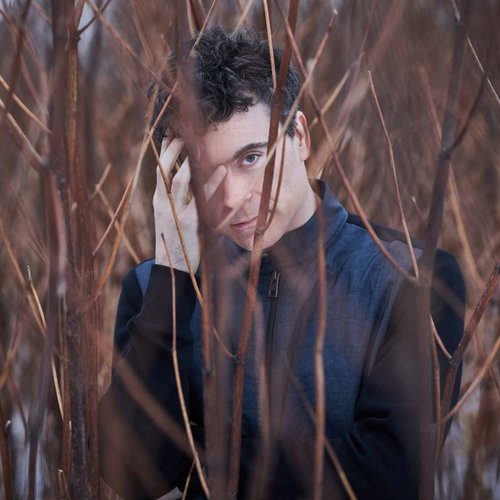
photo: Kaupo Kikkas
The collaboration with Lewis also marks an important occasion for the ensemble, whose relationship to the British Isles is gaining in strength. “This will be the third time for Concerto Budapest to tour in the UK and Ireland since 2022”, Keller says. “I have nurtured many important connections to these wonderful places. Ever since my debut at the Bath Festival over 40 years ago, I have returned many times to perform as a soloist or with the Keller Quartet.”
The ensemble has been scoring one success after the other recently. At the end of September, Concerto Budapest organised a three-day festival in Budapest to commemorate the 80th anniversary of Béla Bartók’s death. The demanding programme included some of the composer’s most popular works, like Bluebeard’s Castle and Allegro Barbaro, together with rarities such as Village Scenes, a collection of three folk songs for female voice and piano. The highlight of the festival, however, were the Concerto for Orchestra and the three Piano Concertos, with soloists János Balázs, Mihály Berecz and Fülöp Ránki. (Barnabás Kelemen and Kristóf Baráti also performed the Violin Concertos, and Máté Szűcs performed the Viola Concerto, together with Miklós Perényi in a version adapted for cello.)
“Three generations of great Hungarian artists came together for this wonderful project,” Keller elaborates. “It was encouraging to see not only so much appreciation for Bartók’s works, but also so many people communicating and bonding through music. My intention was to prove how necessary it is, as individuals and as a nation, to find the time to renew ourselves – and Bartók’s music can be a means to that end.”
Having devoted quite some time and energy to Bartók as a researcher, I am particularly interested in what the composer means to Keller. “Through his fieldwork, Bartók grasped the identity of Hungarians. Travelling around villages to collect the local tunes, he came in contact with a variety of communities, each with their distinct heritage. Instead of discarding such diversity, he embraced its richness and incorporated it in his music,” he reflects. “He saw the dignity and potential of folk repertoire and renewed the European musical canon through this synthesis. I wish for the European Union to retrace Bartók’s teachings – only by listening to and respecting each people can we produce something beautiful. Bartók stood first and foremost for a brotherhood of nations, despite any conflict.”
Concerto Budapest and Paul Lewis tour the UK and Ireland from 29th November to 7th December.
Films of Concerto Budapest’s recent performances of Bartók concertos are streaming on Medici.tv.
See upcoming performances by Concerto Budapest and András Keller.