In memoriam of György Kroó
Liszt Academy, Grand Hall
A Celebration of Hungarian Gems
LISZT–KOCSIS: Goethe Festmarsch, S. 227 (arranged by Zoltán Kocsis)
SCHUBERT–DOHNÁNYI: Fantasia in F minor
VERESS: Concerto for string quartet and orchestra
SZŐLLŐSY: Addio
LISZT: Gondola funebre, S. 134
György KURTÁG - Christoph HEIN: Die Stechardin (orchestrated by Zsolt Serei)
András Keller violin, Miklós Perényi cello, Concerto Strings, Kelemen Quartet, Valentin Magyar piano, Maria Husmann soprano
Conductor: András Keller
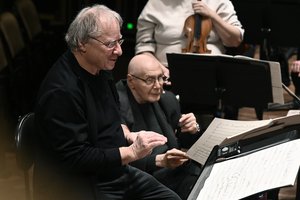
When it comes to marking the death of Zoltán Kocsis ten years ago, and celebrating his inventive work orchestrating earlier works, we all experience a mix of bidding someone important farewell, mourning and festive commemoration.
Thus, the Liszt march to be played at the beginning of the concert, the Festmarsch composed for the centenary of Goethe’s birth in 1849, will be heard in a form that makes Kocsis’s contribution more tangible, as will La lugubre gondola, which was originally one of Liszt’s late piano pieces and whose origin is linked to Wagner’s final days in Venice and his death in the same city.
Following the much-loved Fantasia in F minor, which Dohnányi arranged for orchestra in 1928 on the 100th anniversary of Schubert’s death, and Sándor Veress’s Concerto for string quartet and orchestra, which was created under the joint inspiration of Sándor Végh and Paul Sacher, we will hear András Szőllősy’s Addio, dedicated to the memory of György Kroó.
András Keller, who will play the violin solo in this latter work bidding farewell to a pivotal 20th-century musicologist and music critic, then promises a song cycle by the 100-year-old György Kurtág as the final and main number of the evening.
The soloist for this series of 22 movements depicting the relationship – still alive beyond the grave – between the 18th-century polymath Georg Christoph Lichtenberg and the 17-year-old Maria Dorothea Stechard will be the soprano Maria Husmann, who also sang it at its world premiere in February.