Under the unflashy direction of Andras Keller, one of Hungary’s leading orchestras played with bags of character at Symphony Hall, Birmingham
Review by Rebecca Franks on The Times Thursday December 04 2025
With the German Christmas market in full swing, and one of Hungary’s leading orchestras on stage at Symphony Hall, it was easy to imagine I was somewhere in central Europe rather than the West Midlands as I walked through Birmingham. The Concerto Budapest Symphony Orchestra had stopped off intown as part of its third tour of the UK and Ireland, bringing agenerously packed programme and making the evening an unmissable event.
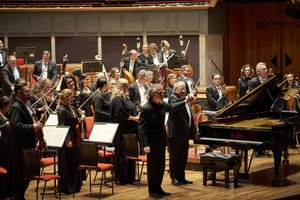
A decidedly traditional one too, in some ways, with theapproach firmly on “great works, great playing”. No panderingto 21st-century trends either: the “no phone” paddles werefi rmly brandished by the concert stewards.
But if that implies a frozen-in-aspic playing style from an orchestra whose history stretches back more than a
century, then I’m misleading you.Under the unflashy direction of artistic director Andras Keller,these musicians were firmly in the moment, playing with realzeal and passion.
Their Shostakovich Symphony No 9 set the bar high. A sardonic Soviet composer might seem like an odd place to begin a concert rooted in the Classical era, but this symphony finds Shostakovich in neo-classical mode, writing for compact forces,wryly playing with sonata form, and subverting the authority’sexpectations for a grand symphony celebrating victory in 1945.
The orchestra brought bags of character to its playing, from perkily alert strings to a wild-edged trumpet solo — so good itmade one of the bassoonists smile. In answer, the bassoonist’s own solo in the Largo was an absolute highlight, wonderfully expressive and fully deserving of the cheers at the end.
Talking of soloists, our pianist in Beethoven’s Piano ConcertoNo 3, which stands poised between Classicism and Romanticism, was the unfailingly eloquent Paul Lewis, who forthe most part found a happy balance between fervour andrestraint. And we plunged fully into the Romantics’ artistic world in a stirring reading of
Les Préludes by Liszt, one of Hungary’s great heroes.
Perhaps it was a curious choice to end with Beethoven’s Fifth Symphony, given the orchestra also played it on its fi rst tourjust three years ago, but there was no shortage of conviction,even if one or two ragged edges showed.
There was an appealing sense of Romantic wonder too, with the Allegro con brio’s oboe solo breaking through as if the clouds were clearing around a full moon, and an almost ghostly atmosphere to the Allegro’s opening.
Encores were in order, sending us back out into the chilly nightwarmed by the fi re of Romanian and Hungarian Dances byBartok and Brahms.