That said, Lewis is in Edinburgh this weekend for an Usher Hall concert marking the only Scottish date in a five-city UK/Ireland tour with the idiosyncratic Concerto Budapest Symphony Orchestra, in which he turns his attention back to Beethoven. He’ll perform the Third Piano Concerto under the orchestra’s music director András Keller, who also conducts Tchaikovsky’s symphonic fantasy Francesca da Rimini, Liszt’s Les Preludes and Beethoven’s Symphony No 5.
Posted on VOXCARNYXS
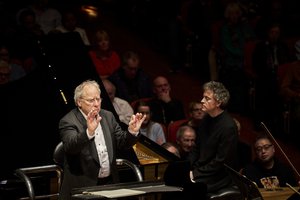
Paul Lewis & András Keller Symphony Hall,Birmignham 3 December, 2025 © Gábor Valuska
Pianist Paul Lewis returns to Edinburgh this weekend. He tells KEN WALTON why ‘just being yourself’ is the key to honest fulfilment amid the noise of social media
Mention the name Paul Lewis, and the music that immediately springs to mind are the seminal piano canons of the great Viennese classicists: Haydn, Mozart, Beethoven and Schubert. “It’s definitely the core of my repertoire,” confirms the 53-year-old Liverpool-born pianist, though pigeon-holing him in such a way is not altogether accurate.
“This year I’ve been playing a big new Piano Sonata by [Austrian pianist/composer] Thomas Larcher, and over the next few years I’ll be embarking on a series of recitals that cast Mozart in context with the likes of Poulenc, Debussy, Webern and Copland. ”I’m hoping the connections will be audible.” Knowing Lewis’ persuasive expressiveness and intellect, that’s a given.
That said, Lewis is in Edinburgh this weekend for an Usher Hall concert marking the only Scottish date in a five-city UK/Ireland tour with the idiosyncratic Concerto Budapest Symphony Orchestra, in which he turns his attention back to Beethoven. He’ll perform the Third Piano Concerto under the orchestra’s music director András Keller, who also conducts Tchaikovsky’s symphonic fantasy Francesca da Rimini, Liszt’s Les Preludes and Beethoven’s Symphony No 5.
Lewis dates his early fascination with Beethoven to frequenting the local Liverpool record library as an 8-year-old. “I guess the librarian there must have had a certain influence on the recordings it stocked. There was a lot of that central Germanic repertoire, coincidentally all of Alfred Brendel’s early Beethoven recordings for VOX/Turnabout in the 1960s.”
At the time, Lewis had not yet seriously engaged with the piano – progress as a budding cellist was proving more arduous than a natural calling – and it wasn’t until he headed to Manchester and the famous Chetham’s specialist music school, that his true metier at the keyboard blossomed. “Later in my teens I turned towards the Romantic piano virtuoso repertoire, but by the time I was a student in London I was focussing again on Haydn, Beethoven and Schubert. I came back to that quite quickly.”
Then he met Alfred Brendel, and with that an opportunity to have lessons with the legend whose recordings had so influenced him as a youngster. “It was such an honour to have that access to him in the ‘90s. Every time I played to him it felt like a door opened musically speaking. He was such a powerful musical personality and had such strong convictions,” Lewis recalls.
“He was so persuasive in the way he communicated things, especially helping you think more creatively about the piano, how to treat it as anything but a piano, which was quite an eye-opener for me. It could be an orchestra, a chamber ensemble, a human voice or a single wind instrument. It was just so inspiring.”
The process was arduous but rewarding, Lewis recalls. “I found I’d play him something and it would take time for me to translate and successfully assimilate all the information. Yes, he was very prescriptive, very specific and exacting in lessons, but in the end he was really only interested in unleashing the personal conviction behind a performance, not in producing clones of himself. I soon realised the worst thing you could do is simply copy him, as all you’d end up with would be a bad version of Alfred Brendel. He wasn’t looking for that.”
Summing up the legacy of Brendel, who died earlier this year, Lewis turns again to shared enthusiasms. “He was the first person to record all of Beethoven’s piano music, and the first person to bring Schubert’s sonatas, previously neglected, into mainstream concert programmes. It’s strange to think he even introduced Liszt to Viennese audiences, a figure they traditionally turned their noses up at. Brendel persisted in what he believed was really worthwhile. Honesty and integrity were always at the centre of what he did.”
These qualities apply equally to Lewis, whose own critically-acclaimed recordings of Beethoven and Schubert, dating from over two decades ago, are already approaching the stuff of legend. What fascinates him most about these, especially the Beethoven, is how differently he views them today. “They would be very different if I recorded them now,” he confirms. “What changes over time is the balance you see between different elements of the music. Back then I get the impression I was looking more towards the lyrical quality of Beethoven, whereas these days I’d probably look towards the dramatic side. I guess you live your life and it feeds into what you do in ways you don’t necessarily understand.”
Lewis’ life has changed immeasurably in recent years, having shifted his family home to Norway (his wife, cellist Bjørg Lewis, is Norwegian), though maintaining a UK base in Buckinghamshire, where he and his wife jointly direct the annual chamber music festival Midsummer Music. He’s also begun to teach, having succeeded his friend, the late Lars Vogt, as a professor at the Hannover Hochschule für Musik.
“It’s the kind of thing I’ve wanted to get more involved with in recent recent years, with young pianists, and often wondered how to do it,” he says. “This seemed like a good opportunity and something I feel I need to do responsibly, so I’m gradually building up a class one student a year and trying to be there as much as I need to be.”
Is there any particular piece of advice he’d like to offload on young pianists today? “I’ve had the career that I wanted to have, focussing early on on certain composers for maybe a year or two, Beethoven and Schubert for instance. I didn’t know it at the time, but looking back it kind of defines you as a certain type of musician and brings an identity along with it.
“These days, with the whole noise of social media, everyone’s out there sort of shouting, so it’s even more important to find a really distinctive identity, though how one does that is another question. My advice is to just be true to the musician you are, have very strong convictions about things. It’s the only way you’re going to convince anyone else. Don’t try to be anything you’re not because you think it will bring x, y or z results in career terms. Just try and stick to your honest musical path.”
Sound advice from a musician whose own journey has been fascinating; who has proved himself to be the genuine article.
Paul Lewis performs Beethoven’s Third Piano Concerto with the Concerto Budapest Symphony Orchestra at the Usher Hall on Sun 7 December. Full information at www.cultureedinburgh.com